September 30, 2013

Quiz: Should You Become a Stay-At-Home Mom?


Are you a working mom of small children who is considering the stay-at-home life? Has the thought been keeping you up at night, and do you fantasize about drafting your resignation at work (stopping just short of visualizing the look on your boss's face)? Do the pluses and minuses of your choice have you feeling overwhelmed and going around in circles?

If so, you've come to the right post. As a former career girl who is now a stay-at-home mom (SAHM), I have worn those same high-heeled pumps and pencil skirts and I can help you decide whether to keep 'em or toss 'em. Here is my quick quiz, with 5 questions designed to help clarify your decision-making process.

(1) Why are you considering staying at home? 
(a) To have more time to focus on my interests, such as fitness, writing or scrapbooking;
(b) To provide regular, nutritionally balanced, homecooked meals for my children, who are growing up with the belief that supper comes from the take-out menu and Walmart's frozen foods section...
(c) To clean the house on a more regular basis..
(d) To save myself from total burnout as a frazzled working mom...
(e) My children miss me during the day and I miss them, I want to spend more time with them...
(f) I'm not happy with any other childcare option...
(g) Other.
Answer key:

If you answered (a), (b), or (c), forget it, you are under the influence of wishful thinking. Reconsider staying home once all your children attend school for the day (although you might wonder, why stay home then?). Few SAHMS of small children have time for these things. Look at me: although I am home all day, my planned photo collages, house-dusting, and even my showers have been put on hold for several years. And yes my dear friends, we are still no strangers to frozen foods and lots of pasta dinners because the pre-supper life of a mom of small kids is hard. So chances are, your house will continue to look like a hurricane aftermath and you will be lucky if you get anything done at all while running after (or occasionally in front of) your little wookies.

On the other hand, reason (d) is totally respectable. If burnout is imminent, don't hesistate to make the move. Self-preservation is key. What's the harm in taking a turn right before the cliff?

Reason (e) is traditional, very worthwhile, and will certainly be achieved. Yes, you sure will spend more time with your children if you stay home. As in, every day, all day, unless you plan to continue them in childcare or kindergarten, in which case reasons (a)-(c) might actually start to get a bit promising. You may even soon surprise yourself by looking for a babysitter, at least for a few minutes a day so you can put on your daytime clothes and eat in peace...it's no fun facing your husband at 5 pm while still wearing your pyjamas.

Reason (f) is my own reason. I just don't believe that any nanny or day care could possibly do an adequate job of replacing me in my children's lives. Oh, I am sure they would do great work in terms of potty training (probably better than me), crafts, and all the other physical, tangible stuff. But my children need more than that. They need real love. They need real attention from a place in the heart. They need the stuff that can't be bought. They also need someone to teach them MY values and beliefs. They need someone to shape their CHARACTER, not just to make their snack and walk them through a museum. They need proper discipline. And above all, they need to know that they are loved and important to me, their mother. And I do believe that to them, time and attention means love.

Reason (g) There are so many possible reasons. If I haven't covered it here, then please comment and let me know what reason you have!

(2) What kinds of things do you expect to do with your children?
(a) I have all these arts and crafts lined up, I've read up on awesome mom blogs and I just can't wait to put all those pompoms, pipe cleaners, finger paint and popsicle sticks into action...
(b) We will enjoy visiting museums, going on outings, discovering the world together, reading books, gazing into each others' eyes...
(c) Just being with them is enough...
(d) I want to homeschool them...
Answer key:

If you answered (a) or (b), you are in danger of being detached from reality. I know, your stay-at-home Facebook friends post photos of their children blowing dandelion seeds and smelling flowers while on their "daily" 2-hour nature walks, etc. And I still haven't figured out how those Pinteresting mom bloggers manage to care for five children and hand-sew all their clothes while inventing new mind-blowing crafts. But it really doesn't matter - chances are high that your life will not look like that.

Being in charge of small children is not for the faint-hearted. While you may get some museums and nature walks and reading in there, don't expect your day to be a perpetual love fest. More likely, you will spend significant time dealing with tantrums, stubbornness, fights, tears, messiness, potty training, illnesses, and especially feeding times. It's not their fault, they are just being little kids. It's the nature of the job.

As a result, you may eventually find yourself sending them out to the back yard instead of going to that museum, so that you can finally get an hour of blissful quiet and check your email as you watch them from the kitchen window, sipping your homemade espresso (caffeine is a total necessity in this line of work).

That's why answer (c) shows the most readiness. You are there to be their mom, and it's true that they need you, but not necessarily in the ways you might at first imagine. Planning a gaxillion activities will burn you out as fast as one of those tealights. Try just being there, and you will see everything else follow.

For little kids, love means TIME. Establishing a life-long close relationship takes TIME. They need you to be there for them, just BE. Be available through the ups, be available through the downs. Be there to hug them, to listen to them, to read to them, but also to discipline them and wipe their bum. Be there to everything. They will know that they are secure under your wings, and that will give them peace to blossom. 

As for answer (d) - that is achievable, but beware of high expectations that might set you up for failure. Where little children are concerned, less is more.

(3) How long do you expect to stay at home?
(a) A couple of months, just to try it out...
(b) About a year...
(c) Until they go off to kindergarten...
(d) I really have no idea, and it doesn't matter, I'm in it for the long haul.
Answer Key

Any of these answers is fine, but don't be surprised if over the course of your time at home, your answer to this question gradually slides down towards (d). Life has a way of spinning spider webs around you wherever you are, and it can get ever harder to step out of the role of at-home mom (of course, you might end up being totally fine with that!). Many, many mothers started out at (a) or (b) and ended up being home right through their children's college years. So it helps to be aware of this as a possible outcome, and you get bonus points for being okay with that option. Which takes us to the next question:

(4) What do you think will happen to your career if you stay at home?
(a) Not much, it will just be put on hold for a while and then I will smoothly transition back in.
(b) I might have a hard time transitioning back in, and that scares me. I don't want to lose everything I worked so hard to achieve.
(c)
My career will be over, completely dead with no possibility of revival.
(d) What career? I only have a job, I'm not a high-falutin' professional momma.
Answer key

Questions about career often carve a very deep, black spiral of worries into our minds as we ponder the possibility of staying home. And with good reason. I am not going to lie to you: not working for an extended period of time does tend to be a career killer, especially in certain linear, traditional fields of work (um, as a former lawyer, law does come to mind...and medicine seems to be another one of those areas that doesn't look kindly on time-outs from the hamster wheel).

If you plan to stay home forever from day 1, then you can skip the rest of this answer since you already don't care. Good for you!

If you answered (a), you are in danger of being idealistic and not realistic. To get an idea of what it's truly like for mothers in your field, look around. What options were there for others? You might be able to follow their path. The key to your mental health is to accept the probable limitations that your choice will impose on your future career, while remaining hopeful and mapping out realistic possibilities for re-entry.

If you answered (b), consider this: A lot of women have the blessing of careers where going part-time from home, doing freelancing or consulting is an option. If this is you, I would recommend looking closely at that choice, especially if you want to re-enter the workforce later. It helps tremendously to keep your foot in the door by staying current and participating in your field of work even on a very limited basis. Later on, as a more seasoned SAHM, you might even discover that you want to continue working part time just to do something outside the home, to nourish yourself and your own life interests. If the part-time "toes in the water" approach is not possible for you, move on to (c).

If you answered (c) but you do want to continue working later, you might consider starting your own at-home business, either something related to your former field of work, or something that taps into other talents or hobbies you have. Check out how many SAHMs are vendors on Etsy. Of course, running your own business can basically turn into another full-time job.

Regarding (d), if you don't have a career to worry about, and yet you can afford to stay home with your children, then it should be that much easier to go for it. Having "just" a job also helps you in other ways. It will probably be easier for you to re-enter the workforce later on, or to work part-time, because continuity in the working force doesn't usually play such a large role at the level of non-professional work (eg. retail).

For what it's worth, here's my own experience:

Staying home for four years has put a gravestone on my legal career, but it's partly by choice. I just cannot be bothered to go back to a career that is so demanding and unfriendly towards mothers, even in its "part-time" form. I also never enjoyed it that much. If I were otherwise inclined, I could try to secure some kind of intense legal work (I don't have enough experience to be a part-time consultant or self-employed) at some point when the children are older, but I am not motivated to do it. I would rather use my degree to pursue other directions that allow me much more freedom and time with my family.

In retrospect, perhaps I should have chosen a career that is better suited to the needs of mothers...but that will be discussed in another post. I do have some regret about not using my law degree, and it's definitely a blow to the ego watching my friends succeed in the working world and climb up the ladder of prestige and income, while I remain home counting cheerios. Read my article about this here.

But you know what? I am realizing that some of my hot-shot working-world friends might well look at me and feel the exact same way in reverse, just like the mom who wrote this letter.

And I am now enjoying my journey as I try out a new path, much better suited to my current needs and life balance - writing.

(5) How well do you handle self-sacrifice?

(fill in the blank) 
Answer Key

If you are used to having your day revolve around you, then staying home will likely come as a major shock to the system. When you work outside the home, you get (at least in theory) praise and rewards for good work, for sticking around a long time, and for  loyalty. These rewards consist especially of promotions and pay raises. You get coffee breaks. You get to feel like an expert at something, you get the growing respect of your peers, and your work may be treated as very important. You might get to go to conferences and teach classes, making you feel even more important and successful. You get to see tangible results. You might get to leave your work behind when you come home. You get to have an office or at least a desk space, and you get peace and quiet to work.

At home, forget all of the above. It's not about you, your importance or your expertise anymore. Your degrees and work successes mean nothing to your kids; you might as well use the back of that Masters Degree as poster paper.

You are suddenly just another mom trying to figure out what works with your kids, and more often than not, you may feel exasperation and a sense of failure or even guilt as your approaches keep sliding off personalities that are different from yours. Even when you score big time in the parenting category, it will probably not be appreciated until your kids are 40 (and don't hold your breath even then).

So, be prepared to give it your all, and to expect nothing back. The concept of self-sacrifice seems totally outdated in our culture, where we are constantly being encouraged to "find our passion," chase our own dreams, pursue "self-realization" and personal enjoyment. But for many parents, self-sacrifice starts to feel much more natural.

I remember the strange feeling I had, looking at my new baby girl, that for the first time in my life I could say with certainty that I would jump in front of a moving car without hesitation just to save a life - her life. Her life could do that to me, and it feels completely natural and right for me to do that. My life is there to protect hers, to enable her to grow and blossom, and I would give it up in a second for her. I knew that, and it made me feel strange to know that with such certainty.

It was then that I understood the truth behind the children's story of The Giving Tree, because I felt just like that tree: ready to be give everything of myself, even to be chopped down, for my little daughter. lt is easy to love those little miracles until it hurts.

And it will hurt. You will give up or bend a lot of yourself. Read about the sacrificial life of one stay-at-home mother here.

The self-sacrificial life is hard. Taking care of small children is also physically hard and mentally draining. There is not much support from society for this kind of work (yet another aspect of the self-sacrifice is that many others will not value what you do).

All these are good reasons why a lot of stay-at-home moms experience anger, sadness, depression, etc. Don't be surprised if that happens to you. It doesn't mean that staying home is the wrong choice, but it does mean that you need more support, and you have to hunt it down.

The good news is, being a parent also makes sacrifices easier. We already know it is the right thing to do, and responding to our children's needs comes so naturally that in a way, we hardly feel the pain because it is so worth it.

Invitation

What are your thoughts on all this? I would love to hear from you. Let's continue the debate and tease out the fine points. Questions, thoughts, anything.

Further Resources

A lot has been written about this topic in many places, and here is one very good recent article:


photo credits: ynnejdrofdarb, Monkey Mash Button and shakestercody via photopin cc


September 25, 2013

9 Reasons Why Working Mothers Have It Easier in Canada

Yesterday I was featured as a guest blogger on Katrina Alcorn's excellent blog Working Moms Break. (Thanks again Katrina for giving me this opportunity!)

Katrina is a powerful witness to the plight of many working mothers in a culture where the frenzied pace of life and the demands of the workplace intersect, casting a great and imposing shadow on the life of the family and the mental and physical health of the mother.

Until recently, she often got asked "How do you do it all?". She writes: "I was a 37-year-old mother of three and somehow, my kids, my marriage, and my career were all thriving. Then, one Saturday afternoon in the spring of 2009, while driving to Target to buy diapers, I broke down. Not my car. Me."

The result was an incredible new book that has just been published this month, entitled Maxed Out: American Moms on the Brink. Check it out!

In my guest post, I wrote about the conditions for working mothers here in Canada. Many people outside of Canada might not be aware of all the benefits that Canadian mothers and fathers can access when they have children, in fact I wasn't aware of these myself until I had a baby!

Some years ago when I lived in the United States, I used to think that 3 months was a generous amount of maternity leave. At my upper-crust law firm in Manhattan, that was the maternity leave that we were given, and it was believed to be on the longer end of convention.

I remember that one of the attorneys in my practice group did take that maternity leave. I wonder now how she must have felt, having to push ahead through the punishing work day while her postpartum body was surely screaming for her newborn, a tiny baby just barely out of the womb and crying every two-three hours for her milk. I don't know if she secretly pumped milk in the bathroom stalls like many young professional women are forced to do. I had little sympathy, being young and single and career-oriented at the time.

After she returned to work she arranged for some kind of reduced schedule, though it was still long by most people's standards. Nonetheless, the hush-hush about this new mother was that she had slowed down and wasn’t a go-getter, and that was probably true. Given her situation, she was probably trying to survive rather than prosper at the firm.

I've since learned that stories like that are distressingly common all across the vast and beautiful Land of the Free, and some of my professional friends have had to make do with much shorter maternity leaves. Americans may wonder, would new motherhood be easier for this female attorney if she lived north of the 49th?

The short answer is: definitely. To find out why, visit my guest post here:

Guest Post: 9 Reasons Why Working Mothers Have It Easier in Canada

photo credit: pfala via photopin cc

September 23, 2013

Why Montessori Homeschooling Doesn't Work For Our Family

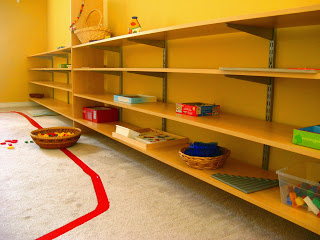
Image of Montessori shelving
Our classroom shelves are nearly bare.
Last year at this time I was in love with the Montessori method. For a while I was so enthusiastic that I told several people about my idea of opening a Montessori school right in our home, and I started contemplating certification as a Montessori teacher.

I bought teaching manuals online. I started reading a slew of books on the method and on homeschooling the Montessori way. I read dozens of blogs by Montessori homechooling moms and I tried to copy their incredible ways. My surprised but supportive husband turned our large family room into a Montessori-style classroom, our home chapel became an Atrium, and I began purchasing Montessori materials from educational suppliers. I also managed to get a number of used Montessori materials from local schools, which donated to me the things they were discarding and replacing with new items (lesson learned: never hurts to ask). 

Eventually I started herding our children into the classroom for daily Montessori-style sessions, and the pliable little sheep were getting initiated into the materials, the printables, and the method. I felt a ray of delight whenever they picked up the pink tower or metal insets or my homemade letter boxes, and they genuinely seemed to enjoy the various Practical Life activities and sensory bins that I was preparing for them on an ongoing basis.

But something kept bothering me.  Despite my conviction that the Montessori method was truly excellent and life-changing, I had nagging doubts about how it was playing out in our home.

Two authors that I discovered at that time contributed to my growing discontent: Carl Honore and Kim John Payne both made tons of sense to me. They both discuss the importance of "slow-parenting" or "simplicity parenting", meaning that it is better to give your child less rather than more: that includes stuff, activities, and even attention. They talk about boredom as a good thing - it fosters real problem solving, real creativity.

Honore's and Payne's words made complete sense to me, and in fact they sounded a lot like my own upbringing, which was rather free-range with hands-off parenting, lots of books and basic art supplies but very few toys and no fancy-schmantzy "materials".

And it struck me that homeschooling the Montessori way was turning out to be the exact opposite of the approach that Honore and Payne described. For one thing, I was turning into a total "helicopter parent". I was constantly having to create trays and bins of practical life and sensorial work, and to put together various printables (just creating all the language materials could easily qualify as a second job) and that was filling up too many of my evenings. During the day I needed to hover around my children, observing them at "work" so I could guide them and respond to them by taking out the materials that were of interest and removing the ones that lay fallow.

The required parental attention and activity was wearing me down, but what started bugging me most was actually the materials themselves. To be sure, they are beautifully crafted and effective teaching tools. But accumulating them in our home made me wonder:  what unconscious lessons are the children getting from the expensive and elaborate clutter of stuff, all focused on them, that is building up in our home?

When I look at the most well known Montessori mom blogs out there, on the one hand I really want to emulate the wonderful things they are doing for their children. But my gut reaction also whispers: wait a second, this is way overboard! "A child is not a project or a product or a trophy or a piece of clay you can mould into a work of art. A child is a person who will thrive if allowed to be the protagonist of his own life." (Carl Honore)

I have now come to believe that the Montessori method, at least as fully applied with its array of requisite materials, really belongs only in the classroom. Not because it can't be effectively used in the home, but because it unintentionally spoils our children by giving them far too much. Too much stuff, expensive stuff that challenges their humility and seriously endangers their character development (I also fear to think what they are unconsciously learning about materialism?). It's one thing to have all these wonderful teaching aids available in a school setting, where any individual child is not their owner. It's a completely different thing for the child to own these materials all for himself.

Montessori homeschooling also gives children too much parental attention, which actually results in the opposite of Maria Montessori's goal - rather than enabling them to become truly free and independent learners, the children learn to become too dependent on the ever-present mom, and they actually experience a loss of freedom due to the need to perform and use all of the fancy and expensive materials that their parents have acquired, as well as the printables and activities that the mom spent her nights putting together.

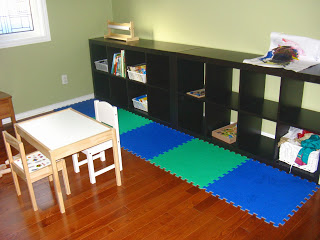
The new look of our main-floor playroom.
And so...I finally got fed up. Not just with the toys, as per my earlier post, but with the amount of child-related stuff in our house overall, whether it be Montessori materials or toys, whether it be neatly arranged on our home classroom shelves or strewn underfoot in the living room. I said I would pare down and I have. Over the last few days I have been filling up bins and taking them down to the basement (which is a mess right now but that's another story).

I was encouraged in my efforts by other bloggers who've taken the same steps: here, here and here (hear, hear!). Also check out this great post.

The results? The shelves are nearly empty in the downstairs playroom and the classroom. Much better than before. Not completely bare, but breathable, airy, not overwhelming. Much less stress.

And the results so far? The children haven't even commented. They appear not to have noticed all the stuff that is missing (even their toy kitchen is completely empty of stuff), or they simply don't care. They don't seem to miss the toys and materials one bit.  They have continued playing peacefully with whatever was left behind. And is it just my imagination, or are they actually more quiet and absorbed in their play for longer periods than before?

Ironically, the only person who misses all that stuff right now is me. I do feel some nostalgia for all the wonderful educational materials and developmental toys that I acquired for them, and I kind of wish they would ask for it back (is it really so unimportant that they don't even care to ask about it?). But mostly I am just so relieved and happy to be free of it all. Freedom from stuff is freedom of mind. I think I needed this lesson far more than my children.

So what is the future direction of our homeschooling efforts, now that Montessori is no longer my holy grail? I'm not really sure right now, I have not decided on a curriculum (this is kindergarten after all, so I'm not sweating it) and maybe we will be a mishmash of various approaches. I will keep trying what works best for us, but I have developed two new criteria for our home school:
  • The instructional method/curriculum must be minimally burdensome for the parent. "Because I am worth it," also known as "I need my sleep." I can't revolve my entire life around preparing materials for the children, so that's out. Ready-made, no-parental-labour curriculums are really appealing to me. 
  • The purchased materials required must be kept to a minimum. No clutter in the home, and very few if any expensive items. Because the children must not think they are the centre of the universe and our spending, house and lives must not (so obviously) revolve around them. And because I have learned a hard lesson: so many materials that promise tons of educational and developmental value are actually just a complete waste of time and money, and don't deliver on their promise. In fact the more you have of these materials, the less value they each deliver.
Right now, Hannah is reading the second set of Bob Books at the pace of one a day and making great progress. She is also zooming through the Canadian Curriculum Press kindergarten workbooks I bought at Walmart. I also just received a bunch of Jolly Phonics stuff that I ordered online, and I absolutely love it. It's definitely the best phonics program I have seen so far, and deserving of its own post (100 Lessons was sleep-inducing over here).

I do still plan to make use of the Montessori way to some extent. For instance, I love opportunities for spontaneous Practical Life exercises in the kitchen (peeling carrots, washing dishes), in the home (dusting, sweeping, folding laundry). I also reserve the right to occasionally purchase a Montessori material if it suits our needs, although I believe that the imperfect substitutes found in the home, while less beautiful and tailored to their purpose, are actually often preferable because they are more natural in the home and they do not pose a danger to the character development of the child.

We'll see where it goes from here.

Photo credit: Lea Singh, All Rights Reserved. For permission to use, please contact me.

September 19, 2013

A Tragedy in Our Neighbourhood

Nature brought out her dazzle this morning, it was one of those early autumn gems that tickles your skin with a light breeze and dapples the gentle sun across your children's hair.

We were enjoying a happy morning, the children were running around the living room playing, when suddenly I received two phone calls asking if my husband was all right. Nothing could be more jarring, as if all the plates had slid out of the cupboard and come crashing to the floor in that instant.

It turns out that on this beautiful morning, five people stepped out of their houses forever when they boarded the 76 Express in our neighbourhood. My husband was not one of them, but this was a very close call.

Today that 76 Express picked up 105 people in my neighbourhood in the city of Ottawa, and hammered through the lowered gate of a railway crossing that my husband and I cross with frightening frequency. The bus slammed full-speed into a passing train. Its front was violently ripped out, bodies fell onto the tracks. Six fatalities, including the driver, over thirty injured, 11 critically...

Why did this accident happen? Witnesses were incredulous. The red lights had been flashing, the bells had been ringing, the crossing gates had come down. The cars on the road had stopped, the train was passing slowly in front of the bus and could be seen clearly by many bus passengers. Some of the passengers were shouting "Stop! Stop!" at the driver as their bus hurtled forward. The driver appears to have missed all the signs and sights of the train in front, and there are conflicting reports of whether he braked at the last second or perhaps not at all. Did he have a heart attack or stroke? Was he suicidal? Did his brakes fail? No one knows at this point. Read more about coverage of the crash here.

I was going to blog about something else earlier, but this tragic crash has been on my mind all day. I can't stop thinking about it, it has shrouded my day in sadness. When my husband came through the door this afternoon after taking an alternate bus route home, we hugged silently. We are both rattled. My husband takes the bus to work every day, and his bus crosses that same railway crossing every morning. This event could so easily have changed our family's entire reality if my husband had been on that bus.

The fleetingness of life. One minute everything seems so hopeful and so permanent, the next minute we are saying goodbye and learning to live with a hole in our hearts.

I have pondered the end of life quite a bit recently. There have been a number of deaths in our close family over the last two years, and all of these beloved members of our family are still being missed. And this June, a good friend passed away at 50 years old after being ravaged by an aggressive cancer. She had not wanted to die (who does?), and her rapid decline had caused her to feel deep sorrow. She had a lot to live for: a loving husband, a young daughter. But the call had come in for her to join Our Lord in her forever home...

Her death left me feeling similar to how I now feel after this bus tragedy. Hollow, sad, quietly grieving.

How can we ever come to terms with death? We are so busy weaving together the bright ribbon of our lives. We fuss about the colours and the patterns, we watch it get longer and longer, and although it does not always end up with the colours and designs that we wish, we are usually very fond of that very special ribbon...and yet we know that there are scissors on the table, and at any given moment those scissors could be picked up by unseen hands and that delicate ribbon could be sheared mercilessly and fall off the spool in a messy coil. How to accept that uncertainty, and how to accept that it will definitely happen one day?

Ever since I've had children I've come to value life so much more. Life in general, their lives, my life. Their lives still seem like such a miracle to me. They were not here four years ago, our house was quiet and still. Now they are here, busily taking over every room, running around, climbing our furniture, laughing and shouting, crying and giggling. Their new lives have filled our house and given us a new sunrise.

Hannah recently told me she feels as if she's always been here because she doesn't remember being a baby. I know what she means, and I remember feeling like that as a child. It's the sense that nothing existed before you, and you always existed somehow. It's a delicious and innocent sense of permanence. Life seems to stretch on forever in all directions.

Now at 36, my perspective on life is changing. I no longer see life as nearly infinite. It is seeming a lot shorter to me these days, and I have started to worry about whether I will be able to live long enough to care for my children until they no longer need me. I realize that I have now probably lived at least half of my life, if not a lot more. It went by relatively fast, and in the future it will go faster still. I am not ready for that. If anything, I want my life to slow down, to enjoy the present and stretch it out like a string of gum. But the foot is off the brake and headed for the gas. And I know that at every moment, there could be sudden impact and blackness.

I think it is possible to say goodbye peacefully. I can imagine that given enough time to prepare I might let go of life with gratitude and contentment, satisfied at what I was given and accepting of what I was not, looking ahead to the journey into the sky and ready to meet Our Lord when He chooses to call me.

But I am nowhere near that yet. I am far too attached to life, to the beauty and the fullness of it. I am far too attached to my children, to the promise they hold of future joys, to the role I have as their mother and the need they have of me. Death, relentless and certain, waits for me somewhere. I hope it takes a long time to find me.

This morning the scissors sheared too close to home, and even our children learned about it. Their innocence is being chipped away, bit by bit. They are now aware that buses can have accidents, and that Daddy takes a bus. They wanted assurance that Daddy could not get hurt on the bus, and Jonah kept saying that Daddy's bus is a single level and not a double decker, as if the accident was somehow caused by the fact that the bus was a double decker. I told them that this kind of accident is very rare and won't happen again, so they don't need to worry and Daddy is safe on the bus.

This afternoon, there was also an accident involving two cars on the road behind our house. Ambulances, fire trucks, a person lying in the grass on the side of the road, swarmed by paramedics. I don't know the outcome, but it sent another tremor into our day.

It has been a sad, sad day.

photo credit: yewenyi via photopin cc
 

September 13, 2013

Help! Our House is Disappearing Under A Mountain of Toys

Just one of our many unused toys...
I have a confession to make: we have way too many toys. As in, mountains. Sir Edmund Hillary might have conquered Mount Everest, but he would risk running out of oxygen if he attempted to climb our Mount Toyland.

I have periodically attempted to downsize, donating trunk-fulls to Value Village and selling on Kijiji. But often I feel like I'm chipping way at the base of a volcano. A few moments after I'm done shovelling away, the volcano erupts and here we go again; it's even bigger than before!

Okay, our house is not yet worthy of that TLC show about being buried alive in your stuff. Some guests might consider our house fairly tidy and not overstuffed, but other guests might internally shudder at our collection of child-related stuff, even if it is neatly stored and displayed rather than spilled and splayed all over the house.

Being within the normal range gives me no comfort at all. It still feels like we are drowning: we are psychologically encumbered by our stuff.

Recently I had the experience of walking into a nice toy store at Bayshore, and suddenly realizing that we already own almost everything of interest that this store has for sale; and yet, to be honest our children don't really seem any better off or developmentally enriched. They don't seem to care much at all for a majority of these supposedly incredible toys.

How did we get to the point where our house is like a toy store? It's a mixture of factors, but mainly it's all good intentions: wanting to provide our children with a rich childhood, which has meant showering them with toys that might spark their hungry little brains and somehow contribute to their developmental needs.

Add to that the fact that no matter what toy the children are given, whether a plastic Little Tikes or cheesy Fisher Price, or the allegedly superior wooden stuff like Melissa and Doug, they will play with it exactly three times: today, tomorrow, and then six months later, on the day you decide to take it away for lack of use (they will inevitably argue that it's their favourite toy).

There are only a handful of toys that have retained our children's interest for a sustained period of time: books, the toy kitchen along with a few pots and some toy food (even there, they repeatedly play only with about a fifth of the actual collection of kitchen items), ride-ons like their bike, trike, scooter, etc., some building blocks (but not all - they prefer the cheaper foam blocks to the expensive wooden blocks), puzzles, and a very few dolls. The rest is just a superfluous overflow, a frothy foam that has been expanding in all directions on all the floors of our house.

The sad fact is that I always knew better than this - so in some ways I find it hard to explain my own actions. I grew up with only a handful of toys, first in Communist Czechoslovakia, where my greatest toys were rocks and sticks, the swing and the sandbox (cool toys like Lego were still just a dream to most kids) and then in Canada as the child of new immigrants who were just getting off the ground and barely making ends meet.

I remember one birthday when my mom surprised me with a truly beautiful doll house that she made from discarded cardboard boxes. I treasured it and considered it more wonderful than any of those gleaming plastic Barbie castles. I often spent hours with my markers and paper, I played a lot with my cats, and my greatest possessions were books; it was heaven to escape into the imaginary worlds that they contained. I also frequented that wonderful resource, the public library. I knew that many of my friends had a lot more toys, but I still didn't feel the least bit deprived. I was perfectly happy and content as a child.

Given my childhood experiences, why do I now feel the need to clutter our house with toys? Am I trying to make up for what I never had, even though I didn't miss it back then?

Maybe. But I also think that I caught the disease of affluence. We have money for so many things in our culture, and those things, things, things just keep accumulating. Every one of those things promises us a kind of deliverance, some kind of improvement in our lives. They are cheap enough that we can acquire them (especially at garage sales - oh, the blight of cheaply available things!) and it is very hard to resist at least trying them out (what if this time, they really do improve our lives somehow?). How could I not get that huge toy baby station for just five bucks, and how could I not take that big Dora dollhouse when the lady offered it for free?

But now I have really had enough. It's time to purge the surge, and get rid of our extraneous stuff.

So I am setting a new challenge for myself this month: to reduce the amount of toys in our house by a third. Maybe I should do more, and if I manage to do at least a third, then there is hope for more reductions.

So let's see if I can really do this - I will keep you posted.

September 11, 2013

Is Having Three Kids Really That Tough?


This post was reprinted on MercatorNet.

Did you know there is a whole website dedicated to information for couples who are deciding whether to make the leap up from two to three children?

At Having Three Kids, Jennifer Eyre White explains that she started the website after attempting to Google for information about this "potentially life-altering decision" and discovering a dearth of info available. So after having her third, she started this resource for the rest of us. Today apparently, the site receives thousands of visitors each month.

It's a bit surreal to see this kind of website pop up online, and it's somewhat disturbing that such a website can become so popular. I guess it speaks to the low birthrate in our society that so many people are blowing up the three child family into some kind of circus-like spectacle, as if it was somehow a "large" family.

Well, we have three under 5, and although it does feel like a daycare at times at our house (okay, every single day), my feet are still planted on the ground. It's still manageable, people! It's not out of control. We don't even own a minivan, although many parents now feel the need to purchase at least an SUV upon learning of their very first pregnancy. We fit all three of our monkeys neatly into the back of our mid-sized sedan, into these narrow, perfectly comfy car seats.

Bottom line, having three kids is not some kind of incredible feat, it's not unusual, and it's just not worthy of having its own website! I mean, I understand people trying to figure out how the Duggars do it, but they have 19 kids. I even understand the fascination of Jon & Kate + Eight. But three? That's hardly newsworthy, even when they are close together in age like ours - and many people have them spread out over such a wide span of years that it's really much more like having two siblings and an only child.

Maybe it's the Catholic in me speaking here. We happen to know so many families who have at least four children, but even up to ten, that we actually consider ourselves on the far end of small. Instead of fretting about how to manage our "large" family, we feel like our house is still quiet, our calendar far less busy and our shopping lists still just a fraction of those of our friends and acquaintances (and our joys, fun and laughter as a family are exponentially smaller too). I mean, among practising Catholics, three is often just an insignificant stop-over on the way to four.

But increasingly, many couples in our culture encounter a very different reality. The author of Having Three Kids explains on her site that "Where I live, just north of Berkeley, hardly anyone has more than two kids. I suspect it's because so many families have two career-oriented parents, and kids are really bad for careers. Or maybe it's because it's so expensive to raise kids here. I dunno. Anyway, when Kennard and I decided to have a third child, we became something of an anomaly in our social circle."

This summer, my husband and I spent some time with a friend from the Czech Republic who had come to Ottawa for a short visit. His description of families in the Czech Republic sounds very similar to the experience of Jennifer White. He repeatedly referred to us a "large family" (which made me uncomfortable because I really don't think we are), and he told us that in the Czech Republic, most couples he knows have only one child. Some do have two children, including him and his wife, but three is unusual. This definitely accords with the stats on the dismal and declining Czech birth rate, where the population is actually shrinking as a result.

Why are children being phased out of our families? Why do so many parents now view having three children with such trepidation that thousands are googling it anxiously each month, looking for answers about "what it's like", not sure whether they can really afford to change their lives in such a seemingly momentous way as having a third baby?

The answers are complex, though I suspect they have a lot to do with the double-income family and the frantic pace of everyday life. We are all swimming with our heads just barely above water, and adding anything else to the mix, especially something as demanding as a baby, threatens to drown us entirely.

Although it seems counter-intuitive, maybe having three (or more) kids is the answer to the strain that society now inflicts upon parents, because if nothing else, having three kids can help us to become still less focused on ourselves, and still less concerned with meeting societal expectations or fulfilling some externally-imposed program for our lives.

Children may seem like the lock, but it might just turn out that they are instead the key to our true freedom.

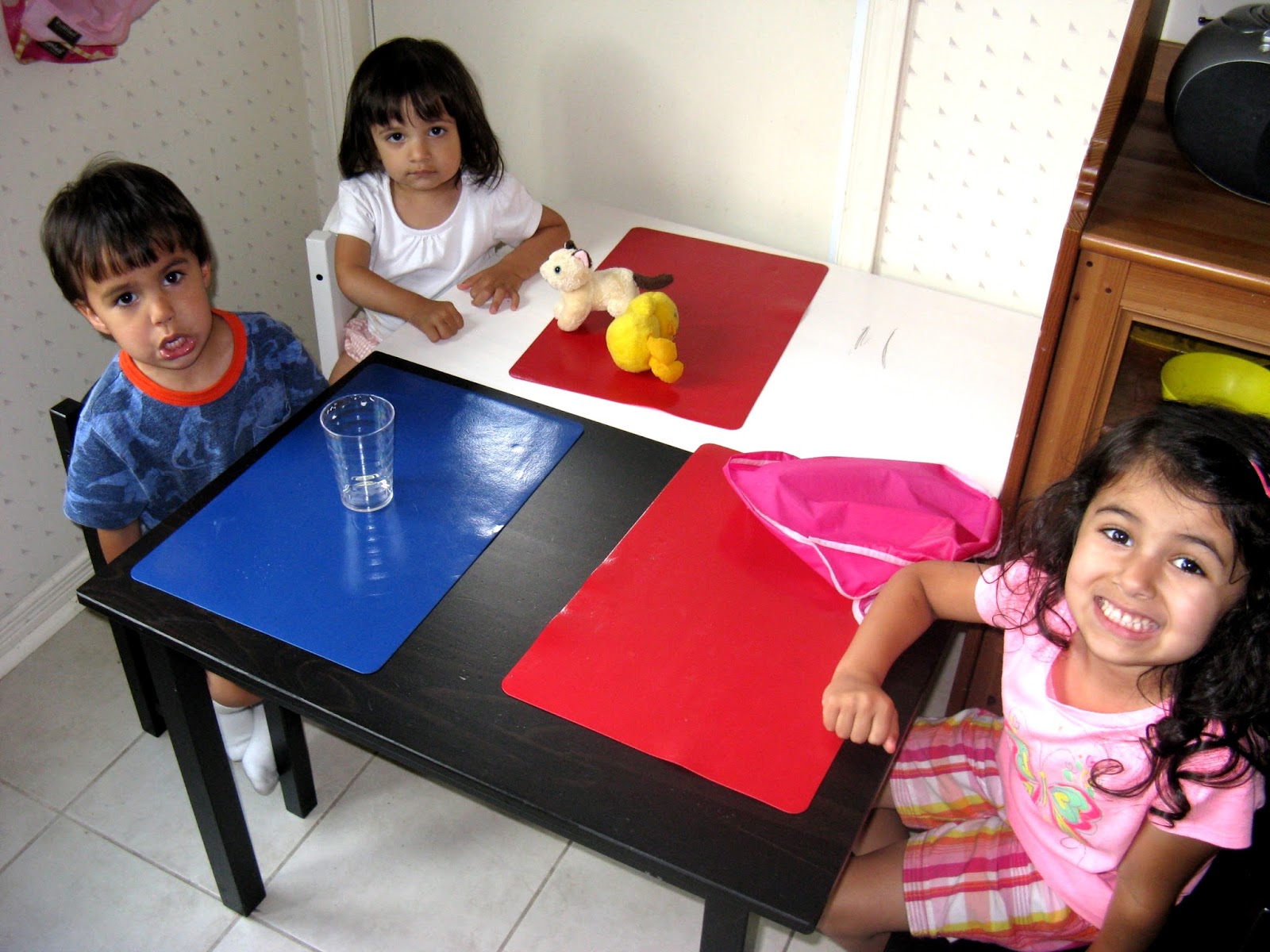
Photo credit, three children: Lea Singh, All Rights Reserved. For permission to use, please contact me. Circus Button photo credit: osolev via photopin cc.

September 10, 2013

How to Motivate Women Back Into the Home

Our culture is so focused on individual achievement and on workplace success that many women are scared of being seen as nothing but mothers and wives.

It certainly doesn't help that much of society considers work in the home as on par with failing to finish school. Surely only someone with no ambitions, only a failure, could be content with staying and working in the home.

It's no wonder most mothers are itching to get back to work. Yes it may be selfish in some ways but who wants to be seen as some kind of retro throwback, content to fluff pillows and jar jams while other women are doggedly juggling a dozen balls with a steely grin?

Happily there is a new movement now in progress in the United Kingdom whose aim is to persuade society that work in the home, the work of mothers in particular, is much more valuable than we usually recognize. This movement is spearheaded by two organizations: the Home Renaissance Foundation and Mothers at Home Matter. Both groups appear to be wonderful initiatives.

I am so excited by the truly unique mission of the Home Renaissance Foundation: "to promote and develop greater recognition of the importance of the work required to create a home which meets the fundamental needs of individual and family and its crucial role in creating a more humane society."

Wouldn't it be fantastic if society embraced this understanding of work in the home? If stay-at-home mothers were valued for helping to create a more humane society, rather than being looked down upon as deserters in the feminist war against home-based oppression, then more women would certainly consider making the choice to work in the home.

The Home Renaissance Foundation is seeking to establish contacts with Canada, and I am cheering for them all the way. May they grow and prosper and may their mission succeed everywhere in North America. We need to hear their message and we need to let it change our postmodern culture.

photo credit: mariateresat. via photopin cc
 

September 3, 2013

Moving Out Bill Gates, Moving In Open Source


For over two years now we have not paid a cent to Bill Gates. We are unplugged from the Microsoft Matrix! It's not that we use MS products illegally. We do not use MS products at all at our house, and we don't have Apple either. I was a reluctant convert at first to this new way of computing, but my husband proved himself right (once again).

Surprisingly, it's possible to function completely normally without having Windows or Word or Excel, because there exist free Open Source alternatives on the Internet that are closely comparable in terms of function and performance. The Ubuntu operating system has convinced me that it is superior in performance to Windows. I now actually enjoy turning on the computer, because startups are a 30-second breeze instead of a dreaded 4-minute drugery.

Lately I am learning to use Gimp, the free photoshopping tool for Linux platforms like Ubuntu. Gimp is a complex program that performs many functions, and there is a steep learning curve. Luckily there are tons of excellent tutorials on youtube. Today I finally figured out how to input and edit text, and this picture is what I came up with. Enjoy!

photo credits in my image: Rachel D (feet) and angusg65 (monkey) via photopin cc
 

September 1, 2013

Asian Fusion Braised Pork with 5-Minute Prep Time

 
How do you prepare a pork shoulder blade roast with a toddler riding on one leg, another child attempting to climb your back, and a third flinging fruit loops across the room?

Hang on, I know exactly what you're going through, and you have arrived at the right recipe.

This mouth-watering Asian Fusion braised pork will leave your guests (or even your incredulous spouse) thinking that despite those three baby monkeys on the loose, you still remain in complete control of your kitchen.

I've liberally adapted a Rachel Ray recipe where prep time was listed as 15 minutes. We know that really means 25 minutes, and when my kitchen is a monkey cage that reads forget it.

Except, I've managed to pare down the recipe to 5 min. real time. Forget measuring ingredients: everything will be eyeballed. And skip the nonessentials; go straight to the must-haves only.
All the ingredientsH

Here's how I did it:

1. Set oven at 325

2. My pot roast was about 5 lbs - unwrap, plop in oven-proof roasting dish
Ready for the oven

3. Ooze Hoisin sauce all over top of roast, eyeballing about 1 cup (a bit more won't hurt)
 
4. Drizzle soy sauce all over, about 2-3 tbsp

5. Drip sesame oil all over, about 2 tsp

6. Pour cider vinegar in a couple of spots (if you have rice wine vinegar, you can use that), about 1 tbsp

7. Peel a few fresh garlic cloves, scatter on top

8. Peel and roughly slice a nice big piece of fresh ginger root, then scatter over the roast
After 30 minutes of resting time

Voila! Preparation is done. 5 minutes are up!

Cover, stick in the oven, just in time to grab the handheld vaccum and pick up those fruit loops. Gotta run, as the children have discovered a new game: crushing those fruit loops underfoot.

9. Leave the roast in the oven for about 3.5 hours.

10. Take out of the oven, let rest for 30 minutes (it gets to what? lucky piece of meat).

11. Remove from pan onto a plate or cutting board, and cut up as you like. It's cook's tasting time! Mine was absolutely fantastic, bursting with flavour, soft and easily came apart. Will make for great pulled pork sandwiches tomorrow!

12. Optional (but really worth it): make gravy with the delicious pan juices. Here's how:

a. Pour your pan drippings through a sieve into another pan, to remove the pieces of ginger root, garlic, and other bits that might be in there.

b. Put the pan on medium heat.

c. In a small bowl, whisk together 2 tbsp of flour with 4 tbsp of water (if your roast was smaller than mine, you might want to halve this recipe). Make sure there are no lumps.

d. Pour this mixture into the pan of juices. Whisk well to mix, then let simmer with occasional stirring until thickened (a few minutes).   

In Rachel Ray's words, Yum-O! Simply out of this world.

Dinner is served!


Wow! How in the world did you make that, Mom?